A First Visit to a Race Weekend: Follow the Session Sequence
Follow a race weekend session by session, so practice, qualifying, support races, and the main event make sense as one unfolding story.
Follow a race weekend session by session, and the changing purpose of each outing becomes easier to see. Practice gives teams room to learn, qualifying sets a starting order, and the race turns preparation into decisions under pressure. You do not need to track every car or technical detail; keep one simple question in mind: what is this session meant to establish?
The exact schedule varies by series and venue. A weekend may include support races, sprint sessions, or a different qualifying format. Check the event’s official schedule before you arrive, then use the sequence below as a way to understand the sessions you see, not as a promise that every event follows the same timetable.
Before the first session
Start with the event schedule, available on the series website, venue page, or official event app. Find the session names and order, along with any support categories. A support race features a separate class or series, often using the same circuit during the weekend. It can be enjoyable on its own, but it does not necessarily determine the main event’s grid or result.
Make a short note of the main series’ practice, qualifying, and race sessions. If there are two races, mark both. Also note whether a sprint session affects the starting order for another race. The schedule or series rules should explain that relationship; if they do not, avoid assuming a sprint is merely an extra race with no effect on the rest of the weekend.
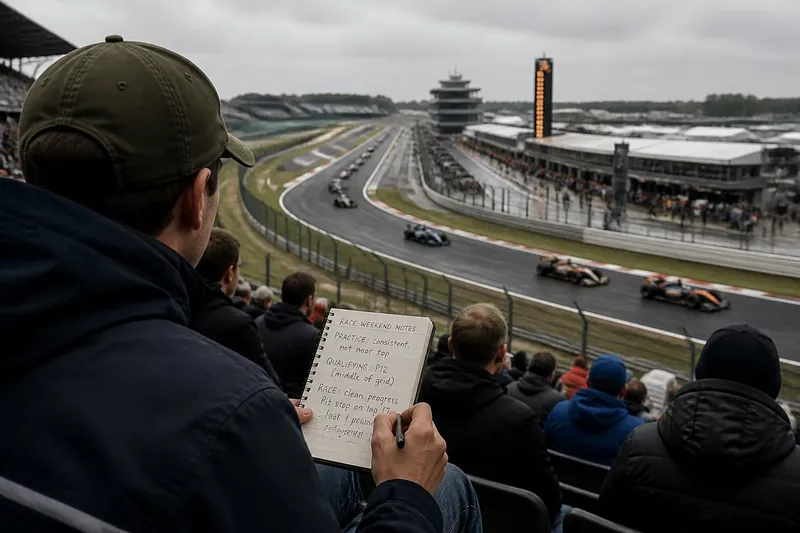
Choose one or two things to follow. For a first visit, useful questions include whether a driver improves across sessions, whether the same cars keep appearing near the front, and how the grid changes after qualifying. A program, phone notes app, or simple paper notebook is enough. Leave room to record the session name and one observation rather than trying to produce a full race report.
Practice and preparation
Practice is the first chance to see how cars and drivers use the circuit during the event. Teams can check car behavior, gather information, and work through setup choices. Setup means the adjustable configuration of a car, such as its suspension balance or aerodynamic settings. These choices influence how the car responds, but a spectator can follow the session without knowing the details of every adjustment.
Watch for patterns, not isolated laps. Does a driver look settled through a corner, or make repeated corrections? Are cars circulating steadily, or do several return to the pits? A pit stop during practice may be part of normal preparation; it does not by itself signal a problem. If timing screens are available, compare a driver’s later laps with their own earlier ones, while remembering that teams may be testing different approaches.
Practice results can be tempting to read as a prediction. Treat them instead as a first clue. Fuel load, tire choice, traffic, and a team’s session plan can all affect what a lap time means. The important point is that practice creates information for the next session; it does not settle who will start at the front.
Qualifying and grid order
Qualifying determines the starting order for a race, though the precise format depends on the series. Some sessions use timed segments, with drivers advancing or being eliminated. Others use a set period in which each driver aims to record a strong lap. Read the event’s format notes or listen to the announcer explain the rules before the session begins.
During qualifying, pay attention to traffic and timing rather than expecting every lap to be a personal best. A driver may slow to create space before a fast lap, while another may lose time behind a car on a different pace. The timing board can show a provisional position, but that position can change as remaining laps are completed.
When qualifying ends, look for the published starting grid. It may differ from the session’s final order if penalties or other official decisions apply. For your notes, record the starting position of a few drivers you want to follow. That gives you a reference point for the race: you can see who gains places, who holds position, and who has to recover from a less favorable start.
Other races and track time
Between main-series sessions, the circuit may host support races, warm-up sessions, or other scheduled activity. Treat each item as its own event rather than as a break in the main story. Support races can help you learn the circuit’s landmarks and get used to following the timing display, even when the cars or rules differ from the headline series.
Track activity also changes the surface. Rubber laid down by tires can affect grip, while weather and temperature can alter conditions. You may hear commentators discuss a track that is “rubbering in,” meaning that repeated running is laying down tire material. For a newcomer, the practical observation is enough: conditions at the end of a busy day may not be identical to those at the start.
If you have time away from the track, check the updated schedule and official notices. A delayed session can shift later activity, and a revised grid can change what you should watch in the next race. Use the event’s own updates rather than relying on an old printed timetable.
The race in context
Before the start, connect the grid to what you observed earlier. A driver who qualified near the front has a different immediate task from one starting farther back. Watch the opening laps for position changes, but do not assume that a quick early gain decides the outcome. The field may settle into longer runs, with teams managing tires, fuel, traffic, or a developing car issue.
As the race unfolds, focus on a few recurring signals: a car closing on another, a driver defending a position, and a team calling a car into the pits. A pit stop can be planned or prompted by changing circumstances. Listen for the reason before interpreting the timing. A stop that costs track position may still fit a broader strategy, while a car staying out may be trying to use clear track or avoid traffic.
Imagine you followed one driver through practice, qualifying, and the race. In practice, you note that the driver is consistent but not near the top of the timing board. In qualifying, the driver earns a middle-of-grid start. During the race, you watch for clean progress and note that a pit stop moves the car behind a rival. The useful story is not simply “fast” or “slow”; it is how the starting position, race pace, and stop shape the result you can observe.
What should you watch?
Does practice predict the race?
Practice can reveal promising pace or handling problems, but it is not a reliable result on its own. Teams may be working on different plans, so compare the session with qualifying and the race before drawing a conclusion.
Why does the grid change after qualifying?
The qualifying order can be adjusted by official decisions, including penalties or other rule-based changes. Check the final published grid rather than assuming the timing screen at the end of qualifying is definitive.
What does a pit stop tell you?
A stop may be scheduled for tires or strategy, or it may respond to an issue. The timing and team commentary offer clues, but a stop alone does not explain the reason.
How much should you write down?
Record a session name, a driver’s position, and one change you noticed. A few clear notes make it easier to connect the weekend’s stages without pulling your attention away from the track.
After the checkered flag
Once the race ends, compare the finishing order with the grid and your notes. Ask which drivers gained or lost places, and whether their progress followed a visible pattern such as a strong start or a stop that changed track position. The result is a useful endpoint, but the session sequence explains how the field arrived there.
For your next event, keep the same small set of notes and add only one new question. You might track how a support race differs from the main series, or listen for how teams describe tire choices. Following a race weekend this way turns the schedule into a connected account: preparation, sorting, and competition, with each session offering a different piece of the story.